
Fine art
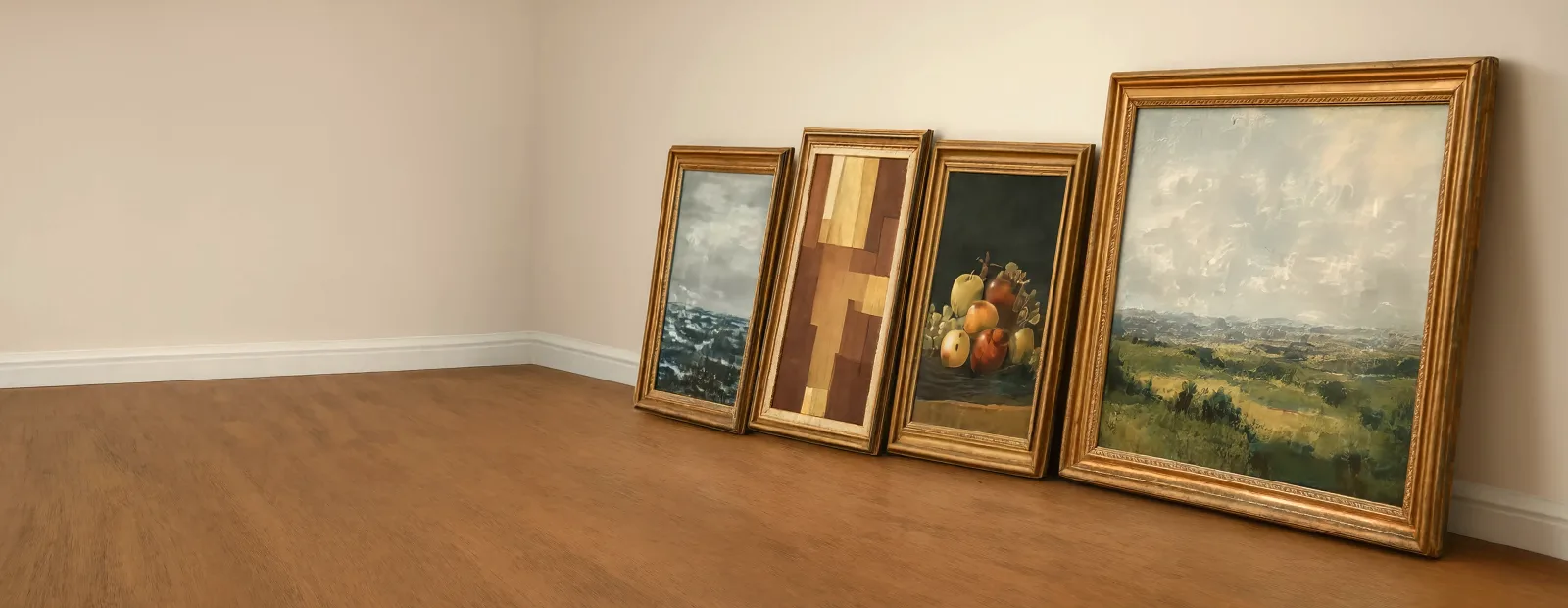
Four paintings, nowhere to hang them.
Art is the hardest thing to sell and the easiest thing to get wrong.
Galleries take a substantial commission and only want what fits their program. Auction houses want work above a threshold and will pass on the rest. Downsizing or settling an estate, people end up either sitting on pictures for years or letting them go at an estate sale for whatever the room will pay — and the room almost never knows what it’s looking at.
Donating routes each work to where it actually belongs. Signed and listed artists go to specialist auction; decorative and unattributed work sells through channels suited to it; and we tell you which is which before anything moves. If a piece is worth more than you think, you hear it from us first.
We take oil and watercolor paintings, original prints and etchings, limited editions, sculpture and bronzes, fine art photography, drawings and works on paper, and mixed collections including the unattributed and unsigned. Proceeds fund medical assistance for families facing costs that arrive without warning, and help keep households in their homes when one bad month puts everything at risk.
Assessed
We identify before anything is sold.
48 hrs
Typical time to hear back from us.
We crate
Large works packed and collected properly.
Tell us what you have
One short form. A real person from our team replies within two business days — no obligation, no pressure.
Prefer to talk it through? Call (888) 228‑7320
Four steps, and we do three of them
Nothing is collected or sold until we’ve told you what we think it is.
1
You photograph the work
The front in daylight without flash, plus the signature, and the back — labels, stamps and old gallery stickers on the reverse often tell us more than the picture does.
2
We tell you what we see
Within two business days. If a work looks like it warrants specialist auction or an independent appraisal, we say so before anything is agreed.
3
We collect or you ship
Large or fragile works are crated and collected at our cost. Small pieces you can ship once we’ve accepted them, and that cost is generally deductible to you.
4
Your paperwork arrives
A receipt on arrival, then documentation of what was received for your deduction.
Questions people ask us about art
I have no idea who painted it. Can you still take it?
Yes, and unattributed work is most of what we see. Photograph the front, the signature if there is one, and the whole of the back — framers’ labels, exhibition stickers and auction lot numbers on the reverse are how attributions usually get made. Sometimes there is a name nobody in the family ever noticed.
Is it a real painting or a print?
A reasonable question and not always obvious. Under magnification a print shows a regular dot or plate pattern where a painting shows brushwork and texture. Send a close-up and we’ll tell you — and a good original print by a listed artist can be worth considerably more than a mediocre painting, so it isn’t bad news either way.
Should I get it appraised first?
Not usually, unless you already believe it’s significant. Where you intend to claim more than $5,000 the IRS requires a qualified independent appraisal anyway, arranged and paid for by you — and for art specifically, the IRS applies extra scrutiny above $20,000 and may refer a work to its Art Advisory Panel. For anything you suspect is important, appraise properly and early.
The frame is damaged, or the canvas has a tear. Does that matter?
Less than you’d fear. Frames are replaceable and surface dirt, old varnish and small tears are routinely restored. Please don’t attempt to clean or repair anything yourself — well-meant cleaning has destroyed more value in paintings than neglect ever has.
Can I donate a whole collection?
Yes, and mixed collections are welcome — the strong works and the decorative ones together. Estates often come with thirty pictures of wildly varying quality, and sorting that out is exactly the work we do.
What can I deduct?
Generally fair market value for work in good condition, and we document what was received. Art is the category where valuation is most scrutinized: above $5,000 a qualified independent appraisal is required, arranged and paid for by you, and above $20,000 the IRS may require a photograph of the work with your return. Speak to your tax advisor for anything substantial.
More on deductions, paperwork and timing — all donor FAQs
Collectibles with Causes
Our dedicated site covers this category in more depth — attribution and provenance, condition and restoration, and how works are placed with the right buyers. Fine art donation and appraisal
You don’t need it to donate. The form on this page starts everything, and our team handles it from there.
Ready to find out what you’re looking at?
Send photographs of the front and the back. There is no obligation.